Hear different stories.
Interview synthetic characters with different knowledge and priorities. Check what they say against records and other perspectives.
My AI Ate My Homework
A new book by Richard P. Mislan, PhD
AI can fetch an answer.
Can it make students think?
Synthetic AI characters carry an unfolding story as students investigate, decide, and encounter consequences. CHARACTER provides nine commitments for designing the thinking that experience requires.
Better performance with AI is not always the same as learning students can use on their own. See the research behind the design ↓
The dog can have the homework.
Keep the thinking.
The story keeps going.
So does the thinking.
In the approach proposed in this book, synthetic AI characters become the manager, customer, colleague, or stakeholder students need to understand. Each has a role, a perspective, and limits to what they know.
As students ask questions and make decisions, the characters reveal information within their roles, challenge assumptions, and respond as the narrative develops. Decisions lead to consequences that give students new circumstances to investigate. Students return to the people and the evidence, reconsider their explanations, and decide what to do next.
The critical thinking is the student’s work: compare competing accounts, check independent evidence, identify assumptions, weigh tradeoffs, defend a decision, and revise it when the situation changes.
The educator designs the objectives, character boundaries, support, consequence rules, and assessment. AI helps sustain the unfolding experience. Deliberate design keeps students responsible for the judgment.
Interview synthetic characters with different knowledge and priorities. Check what they say against records and other perspectives.
Weigh alternatives and make a recommendation. Explain the evidence, assumptions, and uncertainty behind the choice.
Characters react, consequences unfold, and new information appears. Revisit the evidence, revise the decision, and explain what changed.
What matters is the work the learner does.
The book draws on research into active learning, productive failure, and the design of AI-supported interaction. These studies motivate a design question: what should students still have to question, investigate, decide, and explain?
The findings below come from different subjects and settings. They inform the book’s design approach. They do not demonstrate the effectiveness of CHARACTER or its tools as a combined model.
In a field experiment involving nearly 1,000 students, a standard chatbot-style GPT-4 tool improved practice scores by 48% relative to the no-AI group. On the subsequent exam without assistance, that group scored 17% lower than the no-AI group.
A second tool used teacher-informed hints and safeguards. It produced large practice gains without the same later decline, but did not show a statistically significant independent-exam advantage over the control group. The percentages are relative score differences, not percentage-point changes.
The design question: Does support help students practice the thinking they will need when the support is gone?
Read the PNAS study ↗A meta-analysis of 225 undergraduate STEM studies found higher assessment performance and lower failure rates with active learning than with traditional lecturing. The average assessment difference was 0.47 standard deviations.
Productive-failure research examines a sequence in which students first generate and explore possible solutions, then receive structured instruction and consolidation. Under appropriate conditions, this design can support conceptual understanding and transfer. Simply withholding help is not the approach.
The design question: What preparation, challenge, and follow-up instruction will make the effort worthwhile?
A randomized trial in a Harvard undergraduate physics course compared a purpose-built AI tutor with in-class active learning. Students using the tutor showed greater immediate learning gains while spending less time on the material.
The tutor used a structured sequence and research-informed teaching principles. This result concerns that tutor and those lessons. It does not establish that a general chatbot will outperform classroom instruction or develop higher-order critical thinking in every setting.
The design question: How do feedback, pacing, and the sequence of tasks shape what students learn?
Read the Scientific Reports study ↗Longer-term retention, performance on unfamiliar problems, and outcomes for students with different levels of preparation need further study. The research does not isolate one design feature as the explanation for all these results.
Explore the proposed CHARACTER framework ↓A small decision. An incomplete story.
A fictional business has late orders. The manager wants a recommendation before the next busy week. You can spend the budget on staff training, schedule a system repair, or investigate further.
This short illustration uses prewritten responses and fictional records. In the book’s proposed approach, synthetic AI characters sustain role-based conversation as the story, decisions, and consequences unfold.
Who would you ask first? What would you check before choosing a solution?
“We brought in new staff last month. They need better training. I’d put the budget there.”
That is a possible explanation. Which record would help you test it?
“The screen froze during a rush. But I’ve also seen orders waiting between the counter and dispatch.”
This account suggests more than one possible source of delay. Can you separate them?
| Order | Recorded event | Outcome |
|---|---|---|
| 104 | System interruption | Late |
| 105 | No interruption | On time |
| 106 | Wait at manual handoff | Late |
| 107 | New staff, no interruption | On time |
Four records cannot establish the main cause. They do show why neither explanation should be accepted without further checking.
0 of 3 sources opened.
You can decide now or inspect another source first. Each choice carries a tradeoff.
A follow-up record shows a delay involving experienced staff while the system was running. Training may still have value, but it does not yet explain the handoff problem.
Reconsider: what evidence would distinguish a training gap from a process failure?
The repair addresses interruptions, but orders still wait at the manual handoff. The technical fault was real; it was not the only possible source of delay.
Reconsider: which delays would you expect the repair to change, and how would you check?
The team can compare interruptions, handoffs, and staff experience across a larger sample. Meanwhile, urgent orders still need attention. More information has a time cost.
Reconsider: what would you investigate next, and what temporary action could protect customers?
The point is the reasoning you can explain and revise. These branches illustrate design choices, not measured learning outcomes or a scored assessment.
The larger design keeps the narrative and character interactions going as students revisit their decisions. See how CHARACTER makes those commitments explicit ↓
A believable character is not a learning design.
CHARACTER is a proposed planning framework informed by learning research. It is not a validated scale, certification, or a proven intervention.
Before an AI character speaks its first line, decide what students will need to think through. CHARACTER connects the roles, unfolding narrative, evidence, and reviewed consequences to the judgment students must practice.
Each commitment asks a specific design question and names the evidence that makes the answer inspectable.
Name the course, what learners already know, one assessable objective, and the decision they will face. Define what students may use, what they must do independently, and what support stays available.
For example: distinguish two competing explanations using independent evidence.
One scenario. Nine design decisions. Choose a letter to change the question, evidence, and worked example.
The shared case: a fictional business has late orders. Students must investigate conflicting explanations and recommend what to do next. These are planning examples, not reported classroom results.
Why act now?
Briefing and trigger
A fictional business has a growing backlog of late orders. Before the next busy week, its manager must decide whether to invest in staff training, repair the order system, or investigate further. The briefing states the deadline and why the decision matters.
Who knows what?
Character cards
The manager suspects training problems. A frontline employee reports system interruptions. An analyst holds the order timestamps. Each character card states what that person knows, assumes, and cannot verify, so no single interview supplies the whole explanation.
What can students choose?
Action menu and boundaries
Students choose whom to interview, which records to inspect, and which explanation to test first. They may recommend training, a system repair, or a further investigation. The action menu defines available records, time and budget limits, and when students can request a hint.
What reasoning is challenged?
Challenge and hint rules
When students recommend training, the manager asks which record links staff preparation to the delays. If they recommend a system repair, the employee asks whether delays also occurred without an outage. A planned hint points students toward a relevant record without deciding for them.
What can be checked?
Evidence register
The case includes dated order records, incident notes, and staffing schedules. The evidence register identifies each artifact’s source, time period, and limitations. Students compare the records with stakeholder accounts rather than treating any one account as established fact.
What changes after a decision?
Reviewed outcome rules
Faculty review the simulated outcome rules in advance. A training recommendation uses part of the budget; a repair requires scheduled downtime; further investigation delays action. Each branch reveals its stated costs and new information, giving students consequences to examine rather than an unexplained success score.
What must learners do?
Observable performance
Objective: distinguish two competing explanations using independent evidence. Students compare the manager’s and employee’s accounts against the order records, identify what remains uncertain, and explain which recommendation the evidence currently supports.
What will count?
Rubric and evidence map
A rubric assesses how students check sources, compare explanations, acknowledge uncertainty, and justify their recommendation. The evidence map connects those criteria to interview notes, a comparison of the records, and a decision memo. A polished memo alone is not sufficient evidence of learning.
What can be reconsidered?
Second attempt and reflection
After the first recommendation, students receive an additional incident log that complicates their explanation. They revise or defend the decision, identify which evidence changed their confidence, and explain what they would investigate next. Both attempts and the reflection remain visible.
A blank commitment is a design question to resolve. More characters are not a substitute for a clearer learning purpose.
Introduced in Appendix A, alongside Chapters 4, 8, and 14. Read the evidence note and its limits.
Explore what’s inside the book ↓A free CHARACTER planning checklist for your next learning experience. Identify the decision, the thinking students must do, and the evidence you will inspect.
No email or account needed. A one-page, fillable PDF you can save, complete, and print.
Explore the argument, then use the design frameworks and adaptable templates to try a small case of your own.
Practical appendices include the CHARACTER Framework, a synthetic character design card, evidence architecture, a consequence design matrix, a Socratic question map, a Decision Lab blueprint, assessment rubrics, and an implementation roadmap.
What changes when producing an answer becomes easy?
Synthetic colleagues, productive frustration, and questions that teach.
Build situations, evidence, and consequences around learning objectives.
Explore fictional organizations, Decision Labs, and assessment.
The professor as world builder, and a path toward thoughtful adoption.

Richard P. Mislan, PhD
Author & educator ↗
Richard P. Mislan, PhD, is a Senior Lecturer at RIT’s Saunders College of Business. His teaching connects AI, information systems, and cybersecurity with the judgment students need to explain and defend decisions. His earlier mobile-forensics work at Purdue included curriculum, publications, professional training, and the Mobile Forensics World Conference. Today, that applied-learning perspective informs his work in experiential learning design.
Richard’s work explores a question larger than any one tool: what kind of work helps students become capable of acting when the answer is not already given?
He invites educators to consider how technology can make room for more student judgment. A convincing response from a machine is only a beginning. The educational value depends on what the learner has to question, investigate, decide, and explain next.
This book carries that idea into the design of situations worth entering and work worth doing. These are experiences in which decisions matter, evidence deserves scrutiny, and students remain responsible for their reasoning.
The invitation is to keep asking: What is the learner responsible for? What evidence would make a decision stronger? What should remain possible to revise?
The Enter the Possible trilogy explores learning through experience, from the philosophy to the design and construction of situations worth entering.
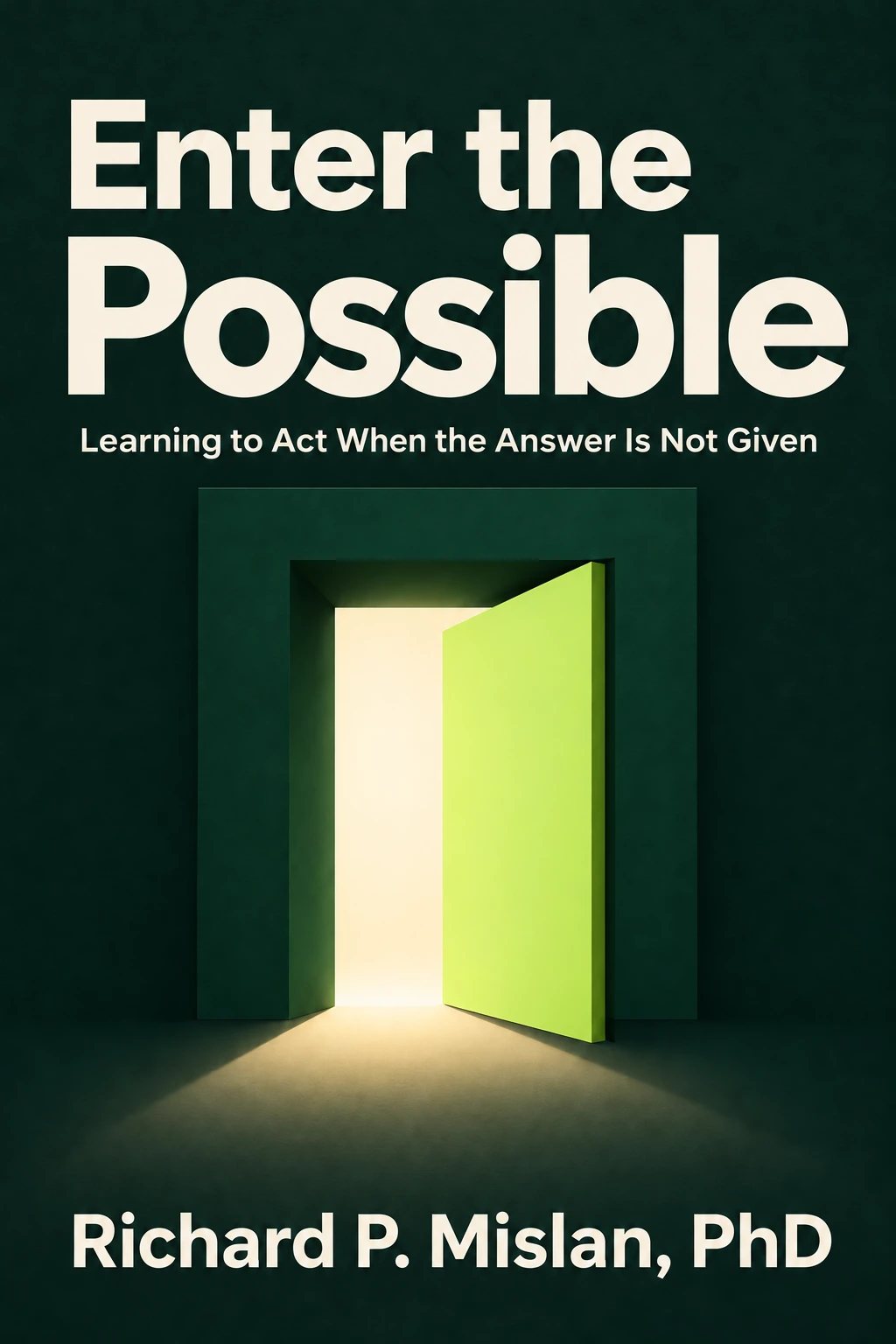
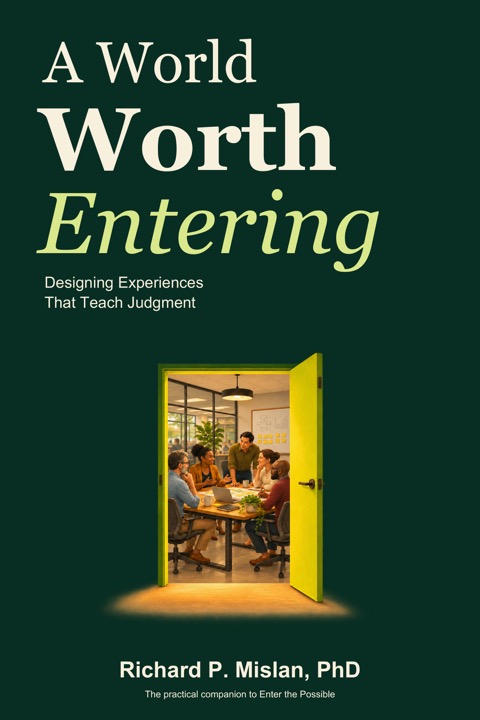
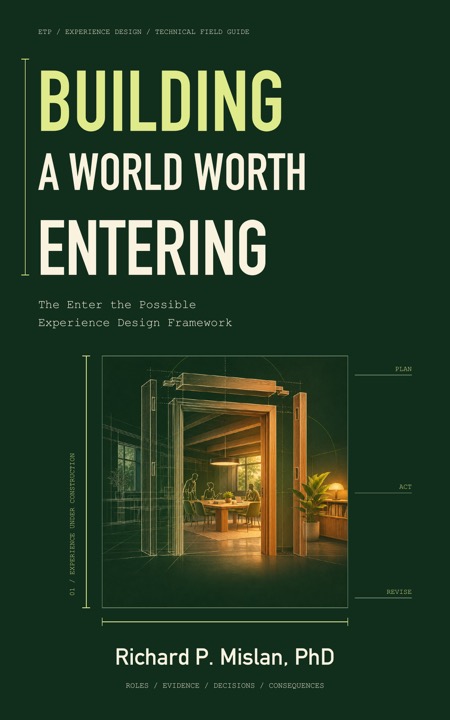
Start with a book. Take it into your classroom. See where the questions lead.
Explore the companion destination at Enter the Possible.